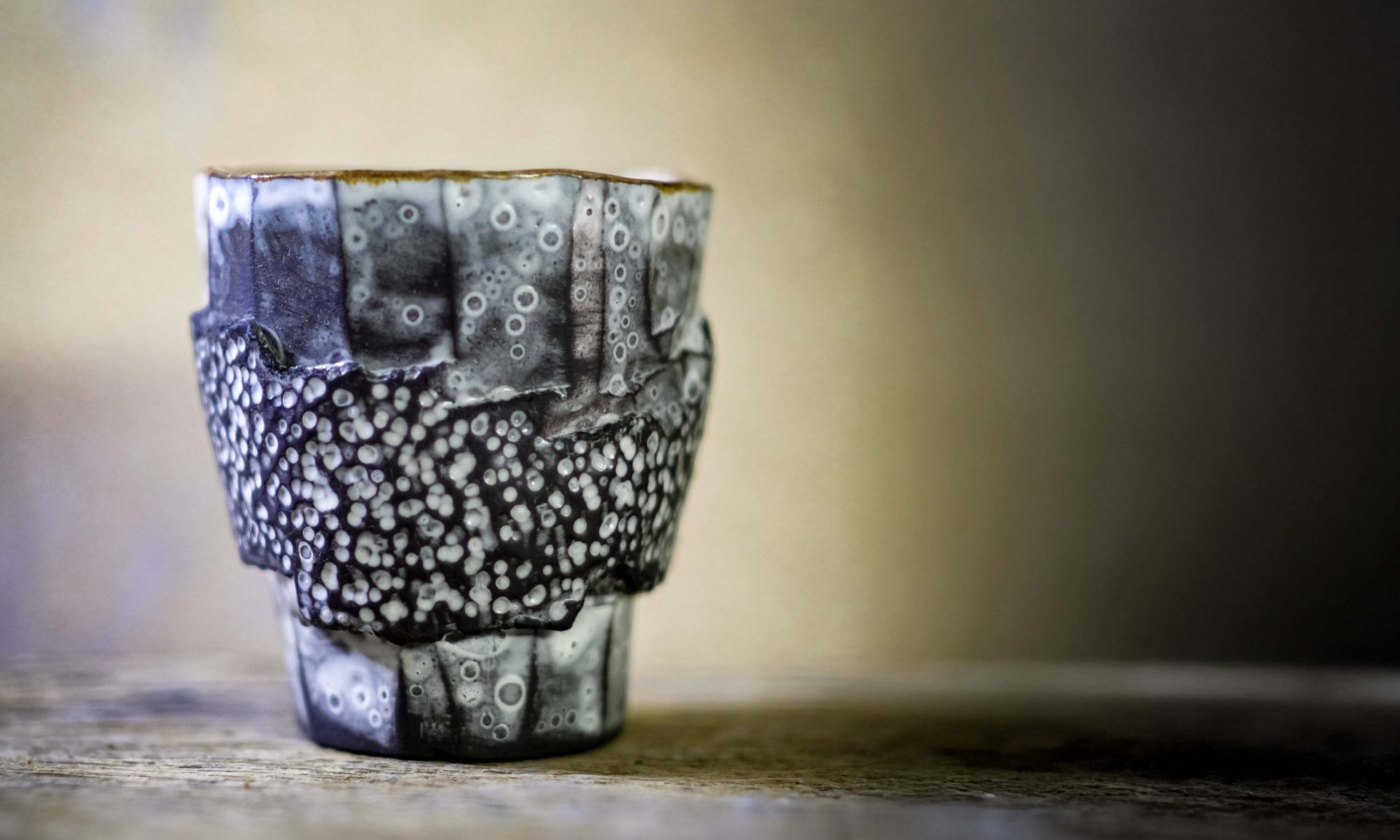
Ich bin im Besitz des Nichts. Und kann es sogar in beiden Händen halten.
Es entstand bei der Arbeit mit Ton aus dem Westerwald. Ich hatte einen Körper geformt und begann ihn auszuhöhlen. Mit jedem Schnitt nahm ich etwas weg. Was verschwand, machte Platz für etwas, das gar keinen Platz beansprucht hatte.
Vor mir steht eine Teeschale. Außen trägt sie die Spuren meiner Arbeit. Doch das, woran ich am längsten gearbeitet hatte, ließ sich weder wiegen noch anfassen.

Das Nichts.
Es reicht vom Boden bis zum Rand. Weiter geht es nicht.
Es gehört mir.
Ein merkwürdiger Besitz. Ein wenig Tee genügt, und mein Nichts verschwindet. Trinke ich den Tee aus, ist es wieder da. Ich kann es füllen, leeren, betrachten und in den Schrank stellen. So einfach kann Eigentum sein.
Inzwischen befinde ich mich im letzten Viertel meines Lebens. Da schaut man gelegentlich zurück und fragt sich, was von all dem geblieben ist, dass man über Jahrzehnte angesammelt hat. Wissen, Erfahrungen, Erfolge, Irrtümer. Auch ein paar unumstößliche Überzeugungen, die sich später als ausgesprochen haltlos erwiesen haben. Mit dem Alter verändert sich auch mein Verhältnis zum Besitz. Früher wollte ich vieles erwerben, bewahren und möglichst vermehren. Heute fällt es mir leichter, mich von Dingen zu trennen. Von manchen Überzeugungen trenne ich mich sogar ausgesprochen gern. Man gibt etwas auf und gewinnt Raum.
Manchmal nehme ich die Schale aus dem Schrank, stelle sie vor mich hin und lasse sie leer.
Meine Welt wird dadurch größer. Seltsam eigentlich. Man gibt etwas auf und gewinnt Raum.
Wie eine Teeschale, die einfach leer bleiben darf.
Natürlich könnte jemand einwenden, dass man das Nichts überhaupt nicht besitzen kann. Er hat recht. Das wirkliche Nichts hat weder Ausdehnung noch Grenzen. Es kennt keinen Boden, keinen Rand und schon gar keine Oberfläche.
Meines hat all das.
Streng genommen habe ich einen leeren Raum geschaffen. Und selbst der enthält noch Luft. Aber ich habe dem Nichts einen Ort gegeben, an dem es sich aufhalten könnte, wenn es denn wollte. Ich kann seine Grenzen mit den Fingern ertasten. Ich kann hineinschauen, ohne es zu sehen. Ich kann es sogar hochheben. Nur für sich allein bekomme ich es nicht auf den Tisch.
Es besteht darauf, sein Gefäß zu behalten. Damit kann ich leben. Wenn ich die Schale jemandem in die Hände gebe, geht das Nichts mit.
Der neue Besitzer kann Tee hineingießen. Eine Blume hineinstellen. Oder die Schale leer lassen.
Was er damit anfängt, geht mich nichts mehr an.
I own nothing. And I can hold it in both hands.
I was working with clay from the Westerwald. I’d shaped a solid lump and begun to hollow it out. With every cut I took a little more clay away. The less clay there was, the more room I had.
A tea bowl stood before me. The outside bore the marks of my hands and tools. The part I’d spent longest making couldn’t be weighed or touched.
Nothing.
My Nothing had a bottom, a rim and an inner surface. It belonged to me.
Pour in a little tea and it disappears. Drink the tea and there it is again. I can admire it, lend it to a friend or put it in the cupboard. Ownership can be remarkably simple.
I’m in the last quarter of my life now. I sometimes take stock of what I’ve gathered over the years. Knowledge, experience, a few successes, some mistakes. And several convictions I once thought unshakeable. They came away quite easily in the end.
I used to want to know what life meant. These days I rather enjoy how much of it still escapes me. Socrates, they say, knew that he knew nothing. Laozi saw that a vessel owes its usefulness to the space inside it. I’d have liked to sit down with them. As it was, I had to make do with a few decades and a lump of clay.
I used to be good at holding on to things. I’m getting better at letting them go. Odd how much room there is when you stop looking for things to fill it. A question can stay open. A silence can sit quite comfortably between two people. The bowl can spend the afternoon empty.
Someone will point out that you can’t own Nothing. Quite right. Nothing, strictly speaking, has no bottom, no rim and certainly no surface.
Mine has all three.
There’s air in it, of course. What I’ve made is somewhere for Nothing to stay, should it ever decide to move in.
It’s there on the table now. I can run a finger round its rim. I can slip a thumb inside and feel where the wall curves into the bottom. It took some Fingerspitzengefühl to get that far. I can lift the Nothing, bowl and all. I have yet to persuade it to sit on the table by itself.
It insists on keeping its bowl. I can live with that.
I can keep my Nothing for as long as I like. It asks nothing of me. And when I let it go, I’ll still have the pleasure of having made it.
When someone takes one of my bowls home, the Nothing goes with it. The same bottom, the same rim, the same surface. Only the hands are different.
A little Eigensinn, perhaps, to insist that the Nothing has a new owner. But there it is on someone else’s table.
They might pour tea into it. They might put a flower in it. Or they might leave it empty.
The rest has nothing to do with me.
The Nothing That’s Mine
The nothing belongs to me. I can even hold it in both hands.
It came about while I was working with clay from the Westerwald. I had shaped a solid piece and begun to hollow it out. With each cut I took a little more away. What I took away made room for something that had never asked for room.
A tea bowl stands in front of me. The outside bears the marks of my work. Yet the part I’d worked on longest could neither be weighed nor touched.
Nothing.
And this nothing had a base, a rim and a surface.
It belongs to me.
An odd thing to own. A little tea and my nothing disappears. I drink the tea and there it is again. I can fill it, empty it, look at it and put it away in the cupboard. Owning something can be wunderbar simple.
I’m in the last quarter of my life now. From time to time I look back and wonder what’s left of all I’ve gathered over the decades. Knowledge, experience, successes, mistakes. I had a few unshakeable convictions, too. Or so I thought. Pustekuchen.
My feelings about owning things have changed with age. I used to want to acquire things, hold on to them and, if possible, have more of them. These days I find it easier to let things go. Some of those convictions I was positively glad to part with.
My world grows larger that way. Odd, really. You give something up and gain room.
Like a tea bowl you can simply leave empty.
Someone might object that nothing is impossible to own. They’d be right. Nothing itself has no dimensions and no boundaries. It has no base, no rim and certainly no surface.
Mine has all three.
Strictly speaking, I have to admit, what I made was an empty space. And even that contains air. So I’m still some way from nothing at all. But I have given it somewhere to stay, should it ever care to. It’s on the table in front of me.
I can trace its edges with my fingers. I can look right into it without seeing it. I can lift it and the bowl weighs just the same. There’s one thing I’ve yet to manage. I can’t take the nothing out of the bowl and set it on the table by itself.
It insists on keeping its bowl. I can live with that. The best of it is that I can pass it on.
Whoever owns it next can pour tea into it. Put a flower in it. Or leave the bowl empty.
What they do with it is nothing to do with me.